
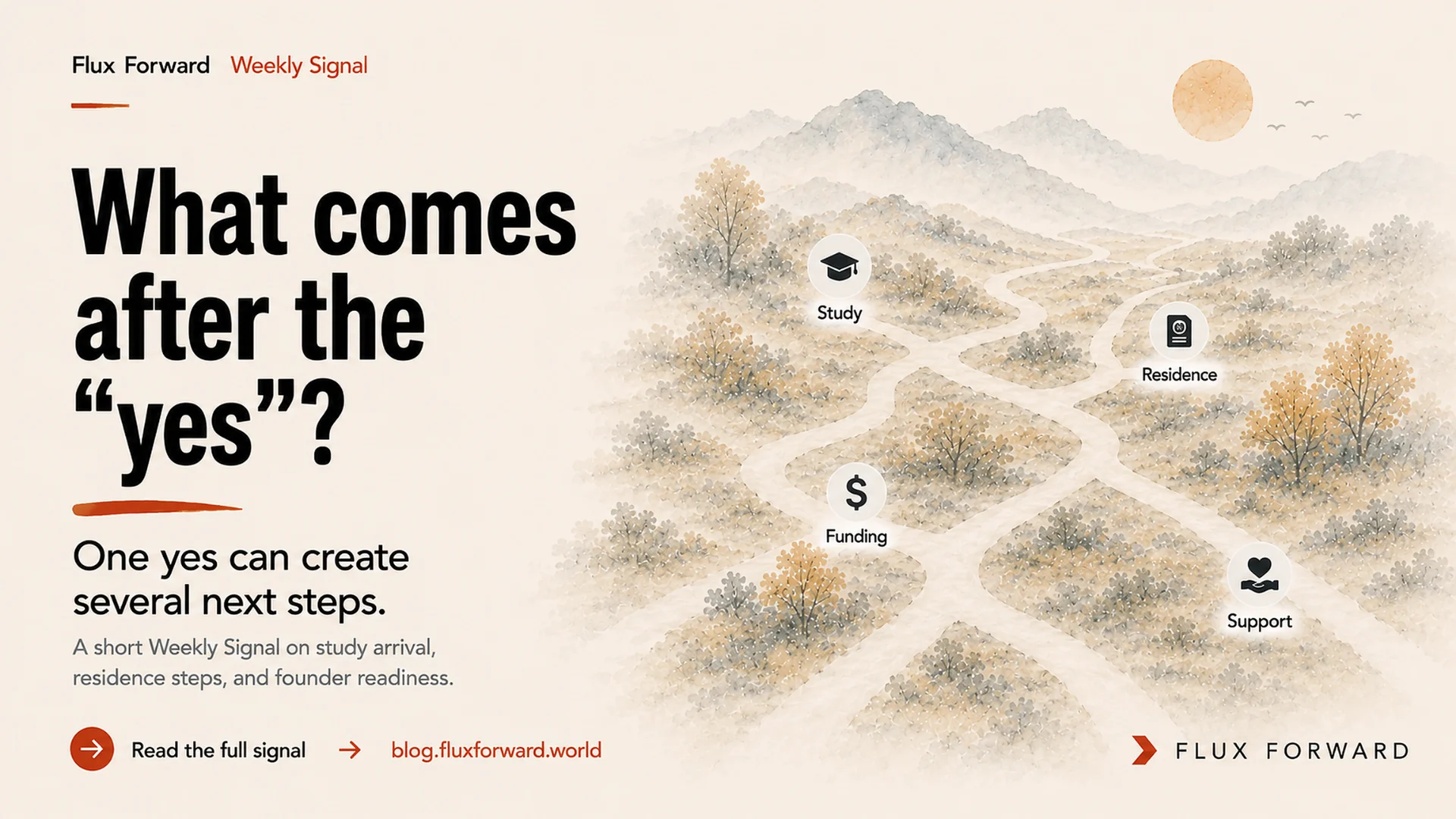
One yes can create several next steps.
A study offer, a residence milestone or a funding announcement can feel like the answer. Often, it is only the start of the next set of steps.
Good news should make things easier, but sometimes it creates more questions.
You receive a study offer. You have lived in the Netherlands for almost five years. You find a funding programme that sounds relevant.
Then you need to work out:
What should I do first?
Which deadline matters most?
What documents do I need?
Who should I contact?
What happens if one part of the plan goes wrong?
Several updates this week showed the same problem. The information is often available. The hard part is knowing what applies to you now and what cannot wait.
A study offer is only the beginning
For international students coming to the Netherlands, admission is not the final step.
RSM, Erasmus University says students called from its IBA waiting list have 14 days to accept or decline their offer through Studielink. After accepting, they receive more information about housing and visa steps. (Rotterdam School of Management)
The University of Groningen advises new international law students to arrive before compulsory sessions start on 26 August. It also points students to introduction activities and its Buddy Network. (University of Groningen)
VU Amsterdam opened registration for its international Master’s and pre-Master’s Introduction Days on 31 July. Its arrival support includes municipal registration, insurance, banking, housing, immigration questions, student cards, healthcare and public transport. (Vrije Universiteit Amsterdam)
Different universities have different processes, but the pattern is similar.
After receiving an offer, you may need to:
accept your place;
check your visa or residence steps;
arrange housing;
plan your arrival;
prepare documents and appointments;
register for introduction activities;
and find the right person to contact.
The challenge is not only completing the list. It is understanding the order.
Some steps have short deadlines. Some depend on another step being completed first.
Start with one question: What is the next deadline, appointment, document or decision I cannot miss?
Five years here does not always make the next step clear
The same thing can happen after you have lived in the Netherlands for several years.
IND guidance on the EU long-term resident permit says applicants usually need at least five continuous years of valid residence in the Netherlands. Income, civic integration, BRP registration and compliance with residence conditions can also matter.
Not every year is counted in the same way. For example, For the EU long-term resident permit, the IND says that previous time spent on a Dutch study residence permit counts for 50% towards the required residence period. Different conditions may apply to EU Blue Card holders. (IND)
This does not mean everyone who has lived here for five years can apply.
The page was updated on 27 July, but that does not by itself mean the rules changed. The useful point is simpler: approaching five years is a good time to check your situation early.
Look at:
your current residence permit;
its expiry date;
how your previous residence years count;
whether income or integration requirements apply;
and which official route may come next.
Temporary permission and long-term stability are not the same thing.
Checking early gives you more time to understand the rules and deal with anything that is missing.
Not every funding announcement is open to founders
Funding news can create the same kind of confusion. A programme may sound relevant, but that does not always mean you can apply.
RVO’s startup mission to Slush Helsinki has already moved from registration to selection and preparation. It was aimed at young technology companies with international growth plans, a scalable model, evidence of demand and a clear funding stage. (RVO.nl)
The useful question now is not whether you can still apply. It is what the programme expected from applicants and what you could prepare before the next opportunity appears.
RVO’s Seed Capital scheme opens on 3 August, but it is aimed at investment funds that invest in young companies. It is not a grant that an individual founder can apply for directly. (RVO.nl)
Before spending time on a funding announcement, check:
Who can apply?
Is it for founders, funds, universities or support organisations?
What stage does it focus on?
Is the application still open?
What proof or preparation is needed?
Which organisations are connected to the opportunity?
A funding announcement can still be useful even when you cannot apply directly, but first, you need to understand what kind of opportunity it is.
A simple next-step check
When one change creates several tasks, write down these five things.
1. What changed?
Did you receive an offer? Are you approaching a permit milestone? Did a new programme open?
2. What cannot wait?
Find the nearest deadline, appointment, payment, document or decision.
3. What needs to happen first?
Check whether the next step depends on another action or document.
4. Who is responsible?
It may be a university, municipality, IND, employer, fund or support organisation.
5. What is your backup plan?
Know where you will go if the first route is unclear, delayed or unavailable.
You do not need to solve everything today. Start with the step that prevents the biggest problem or makes the next steps possible.
Find the right organisation
Official information is often spread across several places.
A university may handle admission. A municipality handles registration. IND handles residence documents. Another organisation may help with housing, student rights, entrepreneurship or the move from study to work.
Flux Forward Actors brings together universities, municipalities, international centers, regional networks, incubators and support organisations across the Netherlands. (Flux Forward)
Start with one organisation that seems close to your situation. Then ask one clear question.
For example:
I have accepted my study offer. Which arrival step should I arrange first?
I am approaching five years in the Netherlands. Which official residence route should I check?
This funding programme is not open to individual founders. Which funds or support organisations are connected to it?
Moving from study to work? You can also use Flux Forward’s Recognized Sponsors lookup to check which Dutch employers are recognised sponsors. (Flux Forward)
The signal this week
A “yes” is progress, but it can also create several new tasks. The useful question is not only: What happened?
It is: What does this mean for me, what comes first and who can help?
When you suddenly have five next steps, do not try to do all five at once.
Find the first one. Check the official source. Identify the right organisation. Then take one practical step.
Not sure where to start?
The Flux Forward Activation Scan helps you look at your situation, see what is unclear and choose one practical next step. (Flux Forward)
Sources and practical links
* This article provides general information. It is not immigration, legal, tax or funding advice.