
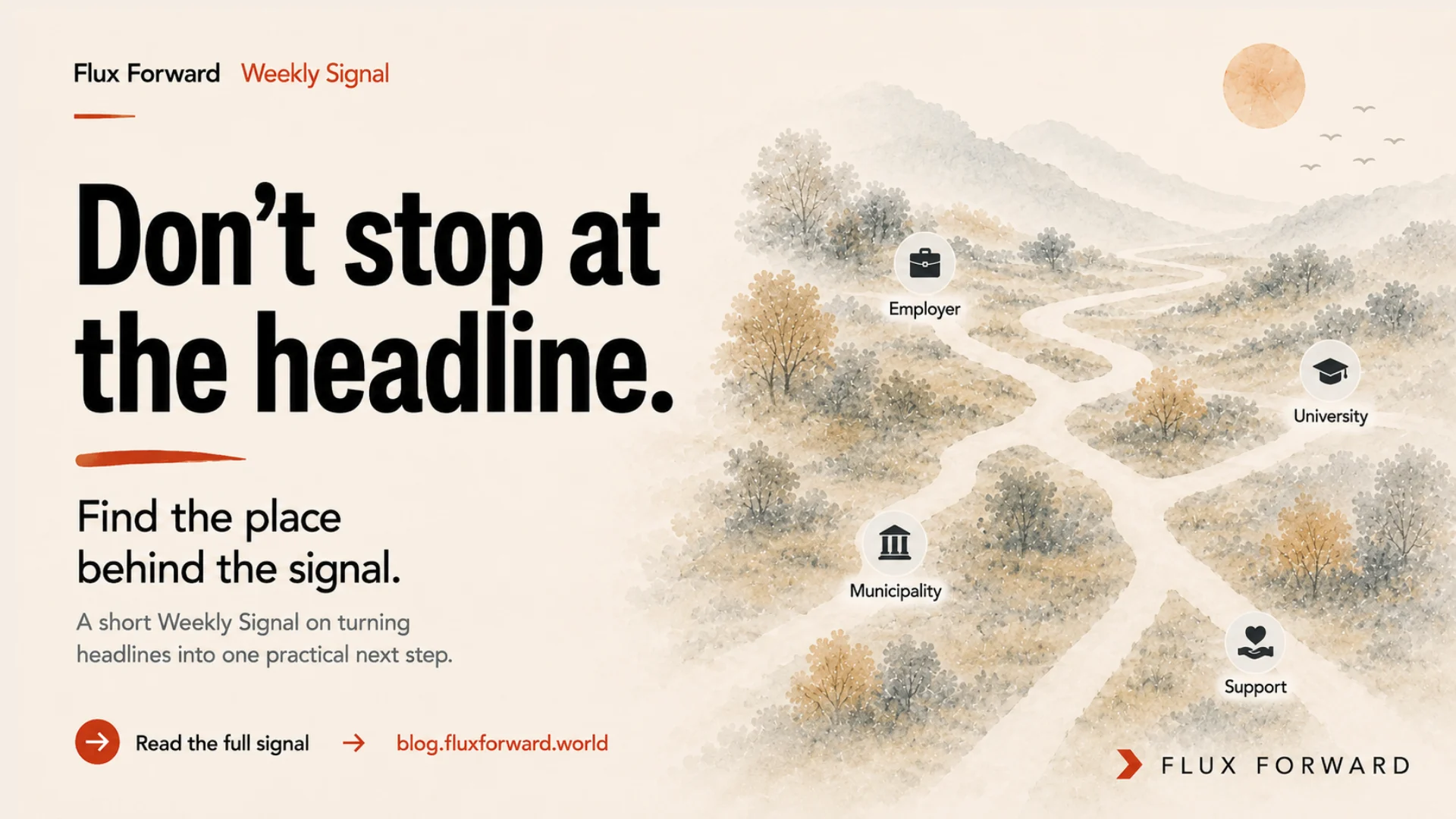
Find the employer, university, municipality, or support organisation behind it.
Several Dutch headlines last week sounded positive for international talent.
The Dutch government published a new Talent Strategy. It focuses on attracting, training, and retaining people in areas such as AI and digitalisation, energy and climate technology, life sciences, biotechnology, defence, and security.
CBS also reported that unemployment was 3.8% in June. But the number of people with paid work also fell. So a “tight labour market” does not automatically mean that finding the right job has become easy.
And in Groningen, regional partners are talking about attracting and retaining more international students and professionals. The focus is connected to shortages in care, IT, and technology.
These are useful signals, but a headline is only the start. The next useful question is: Who is actually connected to this?
A government may say it wants more international talent, but:
Who is hiring?
Which university runs a relevant programme?
Which municipality supports internationals in the region?
Which organisation helps graduates move from study to work?
Which incubator or regional network supports founders?
A national plan becomes useful when you can find the real organisations working behind it.
What this could mean for you If you are looking for work Do not stop at “the Netherlands needs talent.”
Check:
Is your field one of the sectors being discussed?
Which employers are active in that field?
Do they hire international candidates?
Do you need a recognised sponsor?
Is there a local organisation that can help you understand the sector?
The current labour-market numbers show that demand may exist, but access can still depend on language, permits, sector experience, employer knowledge, and local networks.
If you are studying or recently graduated
A region may want international graduates to stay, but you still need to find:
employers offering suitable first jobs;
internship and graduate programmes;
university career support;
local international centers;
orientation-year information;
and organisations connecting education with employers.
“Talent retention” becomes real only when there is a clear next door to knock on.
If you are building a company
The Talent Strategy names several priority sectors. That may help you understand where public attention is moving. But before changing your plans, check:
Is there a programme for your company stage?
Which regional development organisation covers your area?
Is there an incubator or sector network connected to your field?
Is the programme open to international founders?
Is there an actual application, deadline, or contact person?
A policy direction is not yet a funding opportunity.
Start with one real organisation
We recently opened the Flux Forward Actors directory.
It brings together public organisations, universities, municipalities, international centers, regional networks, incubators, and other actors across the Netherlands.
You can use it to find a place that may be connected to your question:
Explore Flux Forward Actors
You do not need to contact ten organisations. Start with one that looks close to your situation. Then ask one clear question, for example:
Do you support international graduates looking for work in this region?
Is there a local programme for international professionals in this sector?
Who should I speak to about founder support in this municipality?
Do you help internationals understand the move from study to work?
Try this in ten minutes
Choose one headline that looks relevant to you. Open the original source. Write down what it actually says, not what the headline suggests. Then search the Actors directory and find one organisation connected to:
your city;
your sector;
your university;
your work route;
or your business question.
Save its name and write one question you could ask. That is already a next step.
Sources from this week
Flux Forward
Flux Forward helps internationals in the Netherlands understand what is unclear and find one practical next step.
A headline can show you what is changing. The next step is finding who is connected to it.