
There was no single big story this week.
But a few separate developments pointed to the same thing.
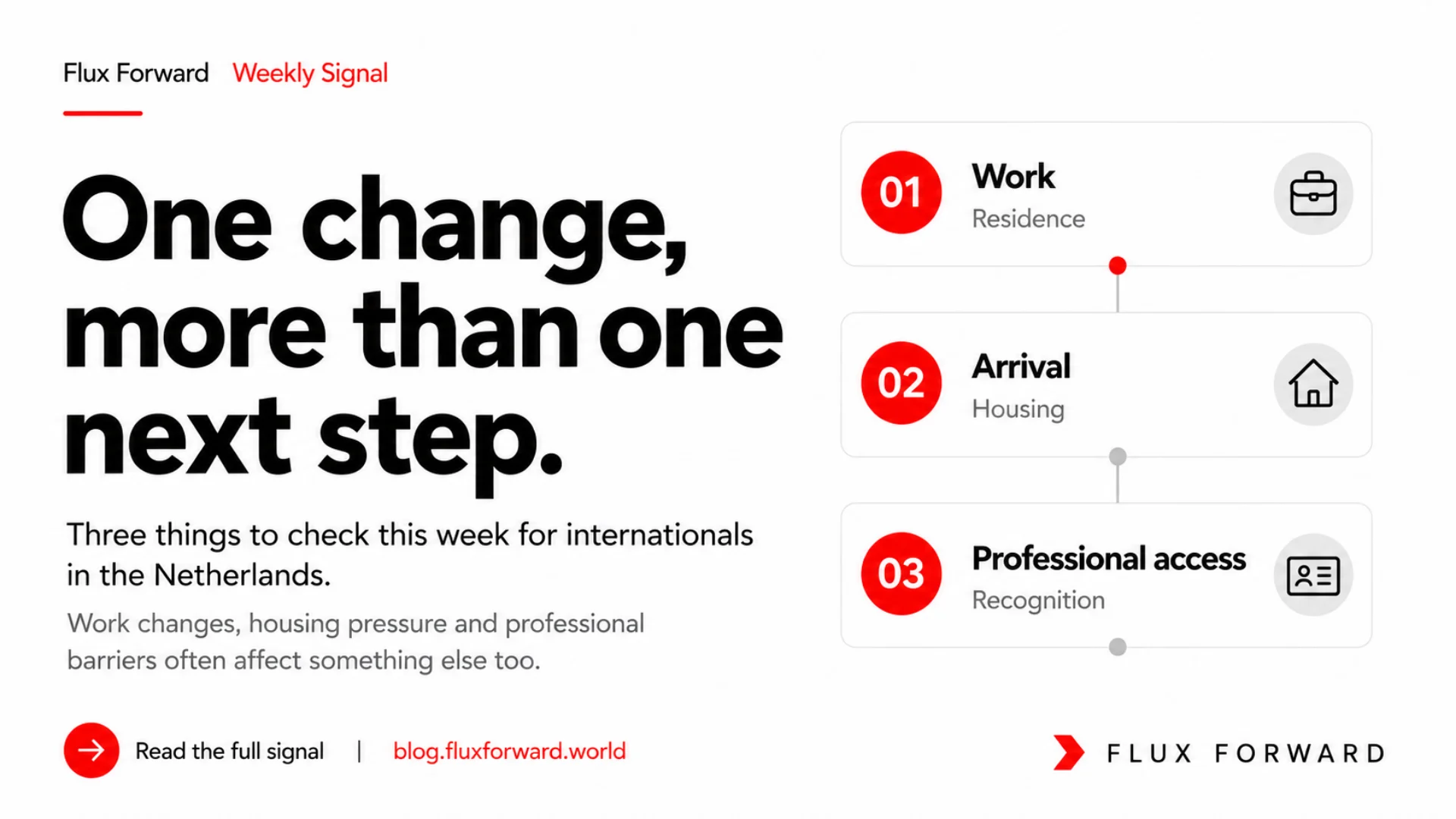
For internationals in the Netherlands, a change in one area often affects something else too.
Losing a job can affect your residence timeline.
Getting admitted to university does not mean your housing and arrival are sorted.
And even when the Netherlands needs people in your profession, recognition, language requirements or registration may still stand between you and the job.
So the useful question this week is not only:
What changed?
It is:
If this affects me, what else do I need to check?
1. If your job ends, start with the dates
New CBS figures show that unemployment in the Netherlands reached 4% in July. Around 404,000 people were unemployed, and the number of people in work fell by an average of 11,000 per month over the previous three months.
These figures are not specific to internationals. But if your right to stay in the Netherlands is connected to your job, a job change can become more than a career issue.
For highly skilled migrants, the usual IND job-search period is up to three months.
There is now an important exception.
If your employment ended on or after 22 May 2026, and you have held this type of residence permit for at least two years, you may qualify for a job-search period of up to six months.
That period can never go beyond the expiry date of your current residence permit. It also starts from the date your employment ends.
So if your job situation changes, put these dates and details next to each other:
- your last day of employment
- the expiry date of your residence permit
- how long you have held this type of permit
- whether a new employer is a recognised sponsor
- whether the new job meets the conditions for your permit
The important point is simple:
Six months is not a general rule for everyone.
Your own dates and permit history determine how much time you actually have.
2. Admission does not mean you are ready to arrive
Last week, we looked at housing, registration, key collection, residence documents and insurance.
The housing part is still worth paying attention to.
A report published on 23 August describes a growing "hidden shortage" in student housing. Some students are no longer actively searching because they have given up, accepted very long commutes or changed their study plans.
University guidance remains clear too.
The University of Amsterdam says it has only a limited number of rooms for international students and cannot provide housing for everyone.
So if you are arriving soon, you do not need another twenty-step checklist.
Before you travel, make sure:
- your housing is confirmed and real
- you know when and how you can access it
- you have checked whether you can register at the address, if needed
- you have a backup if the housing falls through
An admission letter is an important step.
But it is not an arrival plan.
3. A skills shortage does not automatically open the profession
Dentistry gave us a useful example this week.
Nieuwsuur reported that the number of dentists coming to the Netherlands from outside the EU has more than doubled in five years.
This year, 120 people from outside the EU are taking the professional assessment, compared with 53 in 2021.
There are now 2,287 dentists with foreign qualifications working in the Netherlands, and around one in four practising dentists was trained outside the country.
But a shortage of workers does not mean direct access to the profession.
For people with qualifications from outside the Netherlands, the route can include:
- recognition of your diploma
- Dutch language requirements
- professional assessment
- registration in the BIG register
The exact process depends on the profession and where you qualified.
Dentistry is only one example.
If you work in a regulated profession, do not read "the Netherlands needs more people in this field" as "I can start working in this field immediately."
First check:
Can I use my qualification here, and if not, what is still missing?
Sometimes the main problem is not finding the vacancy.
It is getting access to the profession.
Three dates worth keeping
1 September: Forward·Inc Fall programmes
If you have a business or freelance idea and you meet the eligibility conditions, Forward·Inc still has applications open for its Fall programmes.
The Digital Entrepreneurship Program, DEP, is aimed at people at an earlier stage. It is an eight-week online programme covering business fundamentals and helping participants develop their idea.
The Register Your Business, RYB, programme is for people who are further along and want to work on things such as their business plan, financial plan and registration in the Netherlands.
Both programmes are free.
The current application deadline is 1 September 2026.
Eligibility is specific, so check the programme conditions before applying.
10 September: Welcome to The Hague
New to The Hague?
The Hague International Centre is holding a Welcome to The Hague event on 10 September at the Central Library.
The evening covers practical information about settling in, Dutch culture, getting to know the city and meeting other internationals.
Registration is required.
If you are still building your network or finding your way around the city, this could be an easy place to start.
17 September: Permanent Residency session in Groningen
The International Welcome Center North, IWCN, is holding a free expert session in Groningen about permanent residency and Dutch nationality.
The session will cover topics including permanent residence routes, family reunification and how changes such as switching jobs or temporarily working abroad can affect your residence situation.
Registration is required.
If you have already been in the Netherlands for a few years and are starting to think about your longer-term status, this one may be worth checking.
The signal this week
If one part of your situation changes, do not only check that one part.
Work can affect your residence timeline.
Housing can affect registration and arrival.
Skills may be there, while recognition still determines whether you can enter the profession.
You do not need to solve everything at once.
But you should know what the current change affects next.
Start there.
If something in your situation has changed and you are not sure where to begin, the Flux Forward Activation Scan can help you separate the different issues and choose one practical next step.
Sources and practical links
- CBS: July 2026 unemployment figures
- IND: Highly Skilled Migrant, unemployment and finding a new job
- University of Amsterdam: International student housing
- NL Times: Student housing shortage, 23 August
- Nieuwsuur: Dentists trained outside the EU
- BIG-register: Foreign diploma and registration routes
- Forward·Inc: Fall 2026 programmes
- The Hague International Centre: Welcome to The Hague
- IWCN: Permanent Residency Expert Session
This Weekly Signal provides general information. It is not immigration, legal, housing or professional registration advice.