
Your first week in the Netherlands can start before you even get here.
International student arrival programmes are already underway this week. Radboud University’s International Students Summer Intro runs from 16 to 22 August. VU Amsterdam also has Practical Matters Days on 18 and 19 August, covering things like municipal registration, insurance, banking and student cards.
It is a good reminder that arriving is not one task.
Your housing can affect your registration. Your arrival time can affect whether you can collect your key. Your biometrics can affect when you collect your residence document. Starting paid work can change the insurance rules that apply to you.
You do not need a longer arrival checklist.
You need to know which things can block the next steps.
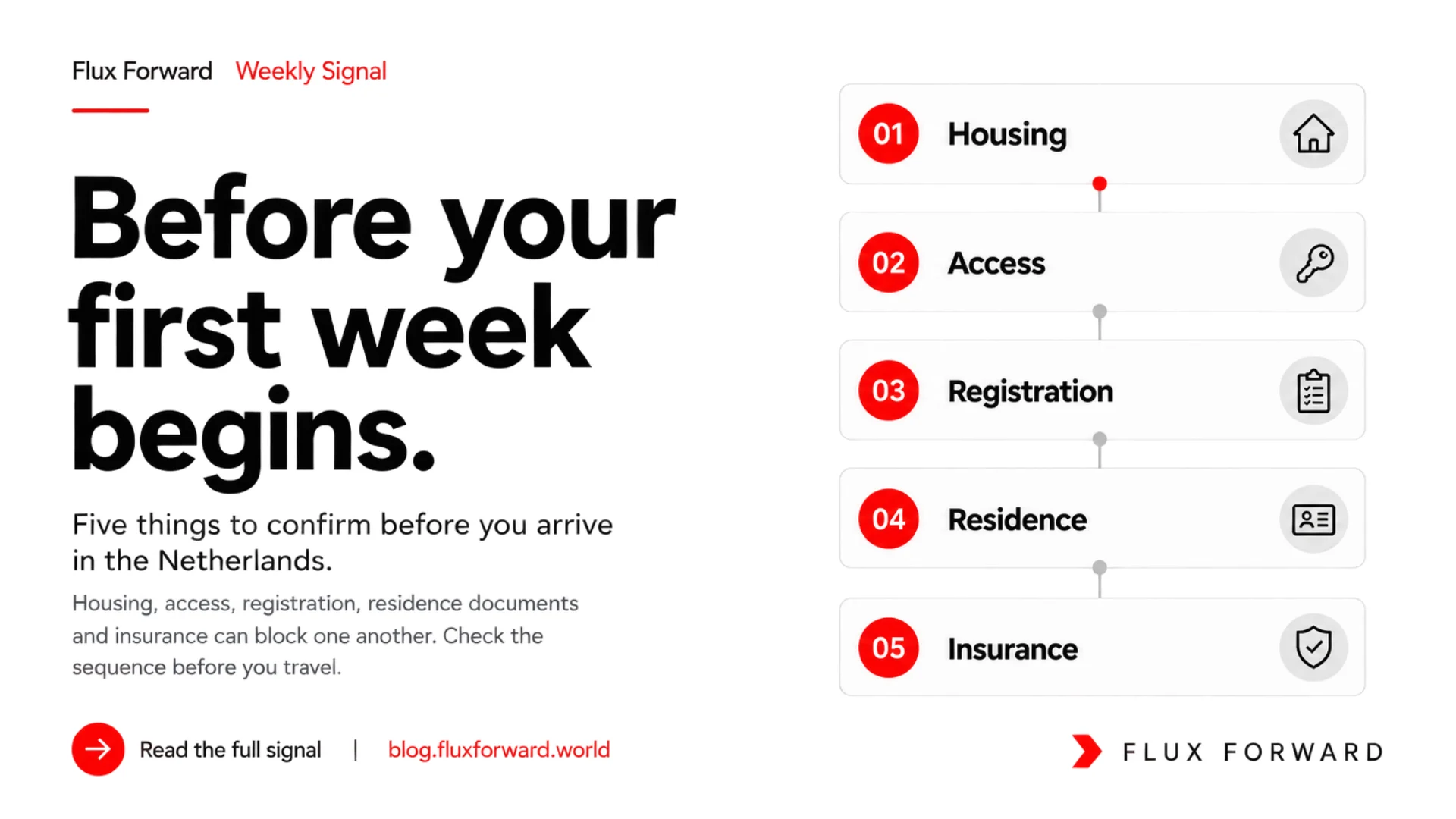
Here are five worth checking.
1. Is your housing real and usable?
Finding a room can put you under pressure to move quickly.
That is also when it is worth slowing down.
Housing scams are a real risk, especially when people are searching from abroad and feel they need to secure something fast.
The LSVb Housing Hotline advises students to be careful with offers they cannot properly verify and to check the room, landlord and contract before paying.
Before you transfer money, ask:
- Have I seen the room, either in person or by video?
- Do I know who I am dealing with?
- Do I have a clear rental contract?
- Do the address, photos and details make sense?
- Can I register at this address if I need to?
- Am I being pushed to pay before I have had time to check the offer?
If you expect to live in the Netherlands for more than four months, registration at your address matters. You will normally need to register as a resident in the BRP at the municipality where you live. (Government.nl)
So if it is unclear whether you can register at the address, check that before treating the housing problem as solved.
If you think you may have been scammed, you can also contact Fraudehelpdesk. International students with rental questions can use the LSVb Housing Hotline.
2. Can you actually get into your accommodation when you arrive?
Having a rental contract does not always mean you can arrive at any time and walk into your room.
Key collection can have its own rules.
For example, the University of Amsterdam tells students using UvA-arranged housing that some keys can only be collected during specific hours. Students may also need their passport and tenancy contract.
If you arrive late at night or during the weekend, you may need to arrange somewhere else to stay that night.
Digital keys can have their own setup too. They may need to be activated before arrival, and you may need internet access on your phone. (University of Amsterdam arrival checklist)
Your own housing provider may work differently.
Before you travel, check:
- When can I collect or activate my key?
- Where do I need to go?
- What do I need to bring?
- Do I need to collect it myself?
- Who should I contact if I arrive late?
- Where will I stay if I cannot get into the property that night?
It is a small check that can save a difficult first night.
3. Do you know how you will register?
If you are moving to the Netherlands for more than four months, Government.nl says you should register as a resident in the BRP within five days of arriving.
When you register, you receive your citizen service number, or BSN. (Government.nl)
If you will stay for less than four months, the non-resident registration route, known as the RNI, may apply instead.
But the exact process depends on where you live.
Municipalities have their own appointment systems and document requirements. The University of Amsterdam, for example, has specific information for students registering in Amsterdam and tells students living elsewhere to check their own municipality. (UvA arrival checklist)
Before you arrive, confirm:
- Am I registering as a resident or non-resident?
- Which municipality is responsible for my address?
- Do I need to book an appointment?
- What documents does that municipality ask for?
- Is my rental contract or other proof of address ready?
Do not assume another student’s registration process will be the same as yours.
Even students at the same university may live in different municipalities.
4. If you need a residence document, are you waiting for the right message?
For some international students, collecting a residence document has its own order.
The IND Student Days for students starting in September 2026 take place in Utrecht on 29 August and 19 September 2026.
You need an appointment.
But the IND also says you should wait until your educational institution tells you that you can make one. If you have not received that message yet, do not book the appointment yourself. (IND Student Days)
Biometrics may need to happen first.
If the IND still needs your biometric data, the current process is:
- Make the biometrics appointment.
- Wait 24 hours after making that appointment.
- Then make the appointment to collect your residence document.
Your educational institution should tell you if this applies to you.
For the Student Day itself, the IND says you need your passport and appointment code.
So the check is not just:
Have I booked an IND appointment?
It is:
Has my institution told me what to do next, and is there anything I need to complete first?
5. Will paid work change your insurance situation?
Insurance can also change when your situation changes.
According to the SVB, an international student who comes to the Netherlands only to study will normally not automatically be insured under the Dutch Wlz scheme and will usually not need Dutch basic health insurance for that reason alone.
But things can change if you start working alongside your studies.
Paid work, paid voluntary work and some internships can affect the rules that apply to you. For internships, the answer can depend on your specific situation, including how the internship is organised and whether you are paid. (SVB: Studies or internship)
So before your first paid shift or paid internship, check again.
Ask:
- Am I only studying, or am I also starting paid work?
- Does my current insurance still fit my situation?
- Has my work or internship changed the rules that apply to me?
Do not assume the answer you had when you arrived will still be the answer a few months later.
A simple check before you arrive
You do not need to solve your whole first month before getting on the plane.
But it helps to know which step could cause problems for the others.
Before you travel, try to confirm these five things:
- Housing
Is the offer real, is the contract clear, and can you use the address as needed? - Access
Can you actually collect or activate your key when you arrive? What is your backup if you cannot? - Registration
Which municipality or registration route applies to you, and what do you need to bring? - Residence document
If this applies to you, have you received the right instruction and completed anything that needs to happen first? - Insurance
Does your current cover fit your situation, and will paid work or an internship change anything?
Then ask one more question:
Which of these could block the next three things I need to do?
Start there.
The signal this week
Arrival is not about finishing the longest checklist.
It is about getting the order right.
A housing problem can turn into a registration problem.
Arriving too late can leave you without access to your room.
Missing biometrics can delay your residence document.
Starting paid work can change an insurance question you thought was already settled.
You do not need to deal with everything at once.
Find the thing that matters next, check the official source, and deal with that first.
If your first week still feels like a pile of disconnected tasks, the Flux Forward Activation Scan can help you see what is unclear and choose one practical next step.
Sources and practical links
- Radboud University: International Students Summer Intro
- VU Amsterdam: Your arrival as a degree student
- LSVb: Housing Hotline
- University of Amsterdam: Checklist for international students
- Government.nl: Registering in the BRP
- IND: Student Days and residence document collection
- SVB: Studies or internship and Wlz insurance
- Fraudehelpdesk: Report fraud
This Weekly Signal provides general information. It is not immigration, legal, housing or insurance advice.