
One of the reasons the Netherlands is attractive to international students is simple: you can do a lot in English.
You can find English-taught degrees. You can use English in many parts of daily life. And when you first arrive, you do not necessarily need Dutch to get started.
New research from Nuffic confirms how important this is. English, both in education and daily life, was the main reason many international bachelor students chose the Netherlands.
But some students said they realised later that Dutch mattered more than they expected, especially for social life and finding part-time work.
That is a useful distinction.
You may not need Dutch for everything.
But there may be parts of your life where it changes your options.
Here are three worth checking.
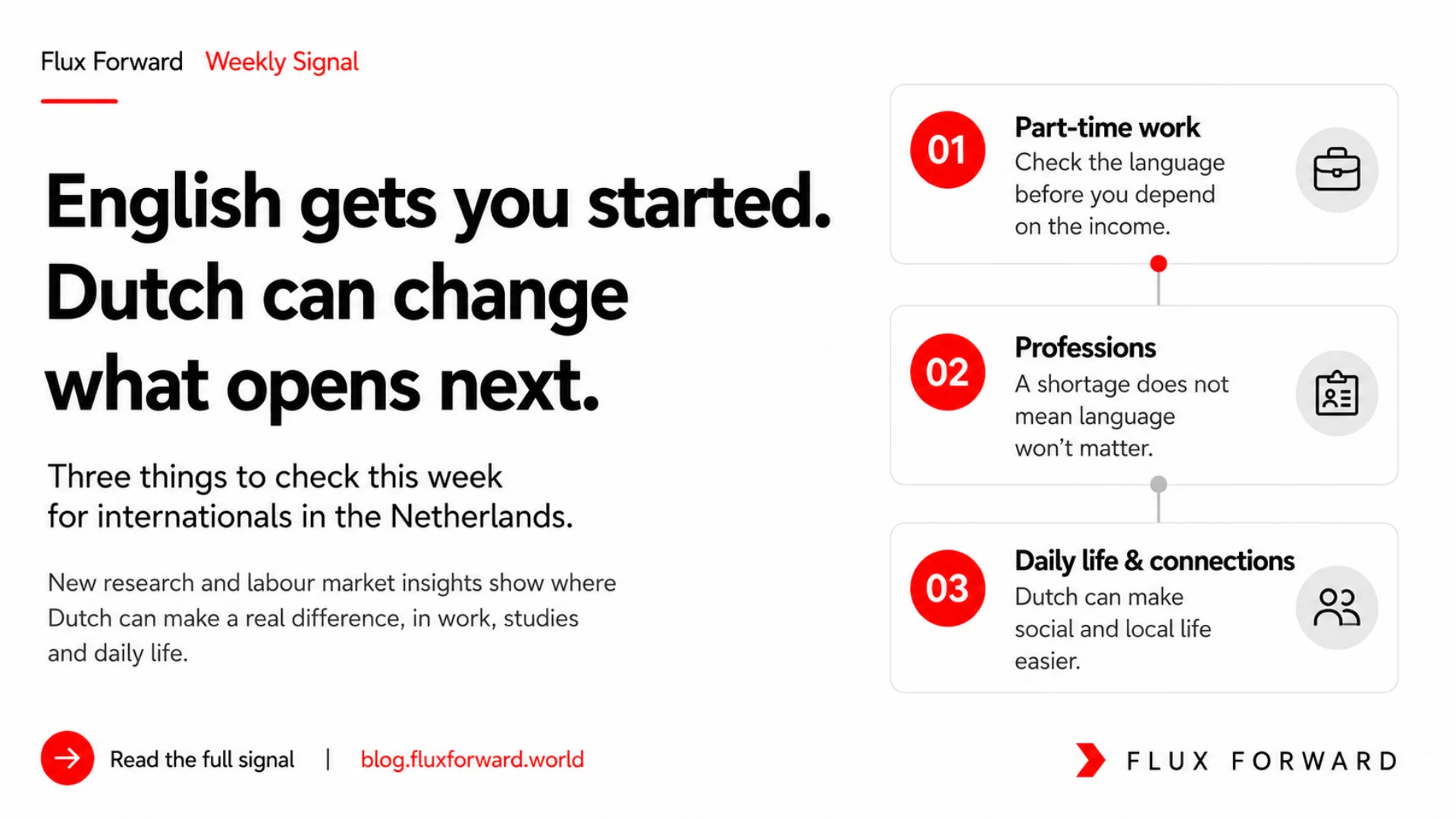
1. If you need a part-time job, check the language before you depend on the income
Studying in English and finding work in English are two different things.
Nuffic found that some international students had underestimated how useful Dutch could be when looking for part-time work.
That does not mean every student job requires Dutch.
Some employers are comfortable working in English. Others may need Dutch because you are dealing with customers, colleagues or local systems.
So if part-time income is important to your budget, check the jobs you could realistically apply for.
Look at a few current vacancies and ask:
- Is Dutch required?
- Is it preferred, or just a bonus?
- Are there enough English-speaking jobs around me?
- What happens to my budget if finding work takes longer than expected?
Do this before you start depending on income that may be harder to find than you thought.
2. A shortage in your profession does not mean language will not matter
The same issue appears in the wider job market.
UWV says the Netherlands has 193 shortage occupations. For 184 of them, there is a surplus of workers in at least one other European country.
So there are cases where the Netherlands needs workers and people with those skills are available elsewhere.
But moving people into those jobs is not always simple.
UWV points to language, work culture and diploma recognition as barriers. In healthcare, Dutch-language skills and diploma recognition are especially important.
If your profession is on a shortage list, that is useful information.
It does not tell you the whole route into the job.
Check:
- Do employers in my field hire people who do not speak Dutch?
- Is Dutch needed because of customers, patients or colleagues?
- Does my qualification need to be recognised?
- Is my profession regulated?
- Is there another registration or assessment I need first?
A shortage can improve your chances.
You still need to know what stands between you and the actual job.
3. Dutch can also change life outside work
The language question is not only about employment.
Nuffic also found that some students underestimated how much Dutch could matter for social integration.
That experience will not be the same for everyone.
You can build friendships in English. You can join international communities. You can live, study and work for years in environments where English is normal.
But outside those environments, Dutch may make some things easier.
It might help when talking to neighbours, joining a local club, speaking with colleagues outside formal meetings or taking part in something that is mainly organised in Dutch.
You do not need to turn this into another pressure to become fluent as quickly as possible.
The better question is whether Dutch would help with something you actually want.
So, should Dutch be a priority for you?
It depends on what you are trying to do next.
If you are here for a one-year English-language programme, your answer may be different from someone who wants to build a long-term career in the Netherlands.
A software developer in an international team may have different needs from someone working in healthcare.
And a student looking for part-time work may have a more immediate reason to learn Dutch than someone who already has a full-time English-speaking job.
A few questions can make the decision clearer:
Work
Would Dutch give me access to more of the jobs I actually want?
Profession
Does my field require Dutch, or strongly prefer it?
Daily life
Where would Dutch make things easier for me now?
Connection
Are there local groups, activities or relationships I would like to take part in more easily?
You may decide Dutch should move higher on your list.
You may decide something else is more important first.
Both are fine. The useful part is knowing why.
One date worth keeping: 16 September
Nuffic is holding a free online webinar on 16 September about the research behind this week's signal.
The session is aimed mainly at higher education professionals and policymakers and will cover why international bachelor students choose the Netherlands and how their expectations compare with their experience here.
The signal this week
English makes it much easier to get started in the Netherlands.
For many internationals, that is a real advantage.
But after a while, you may find places where Dutch would give you more options.
That could be a student job.
It could be your profession.
Or it could simply be a part of local life you would like to enter more easily.
So you do not need to start with:
Do I need Dutch?
A more useful question is:
Where would Dutch make a real difference for me?
Check that first.
Then decide how much time and priority it deserves right now.
If you are trying to work out what matters most in your situation, the Flux Forward Activation Scan can help you separate the different questions and choose one practical next step.
Start the Activation Scan →
Sources and practical links
- Nuffic: English is a key factor when choosing to study in the Netherlands
- Nuffic: Why pursue a bachelor's degree in the Netherlands?
- UWV: Vaak aanbod in Europa voor Nederlandse tekortberoepen
- Nuffic: Nuffic Connects Webinar: Why pursue a bachelor's degree in the Netherlands
This Weekly Signal provides general information. It is not employment, immigration or professional-registration advice.