
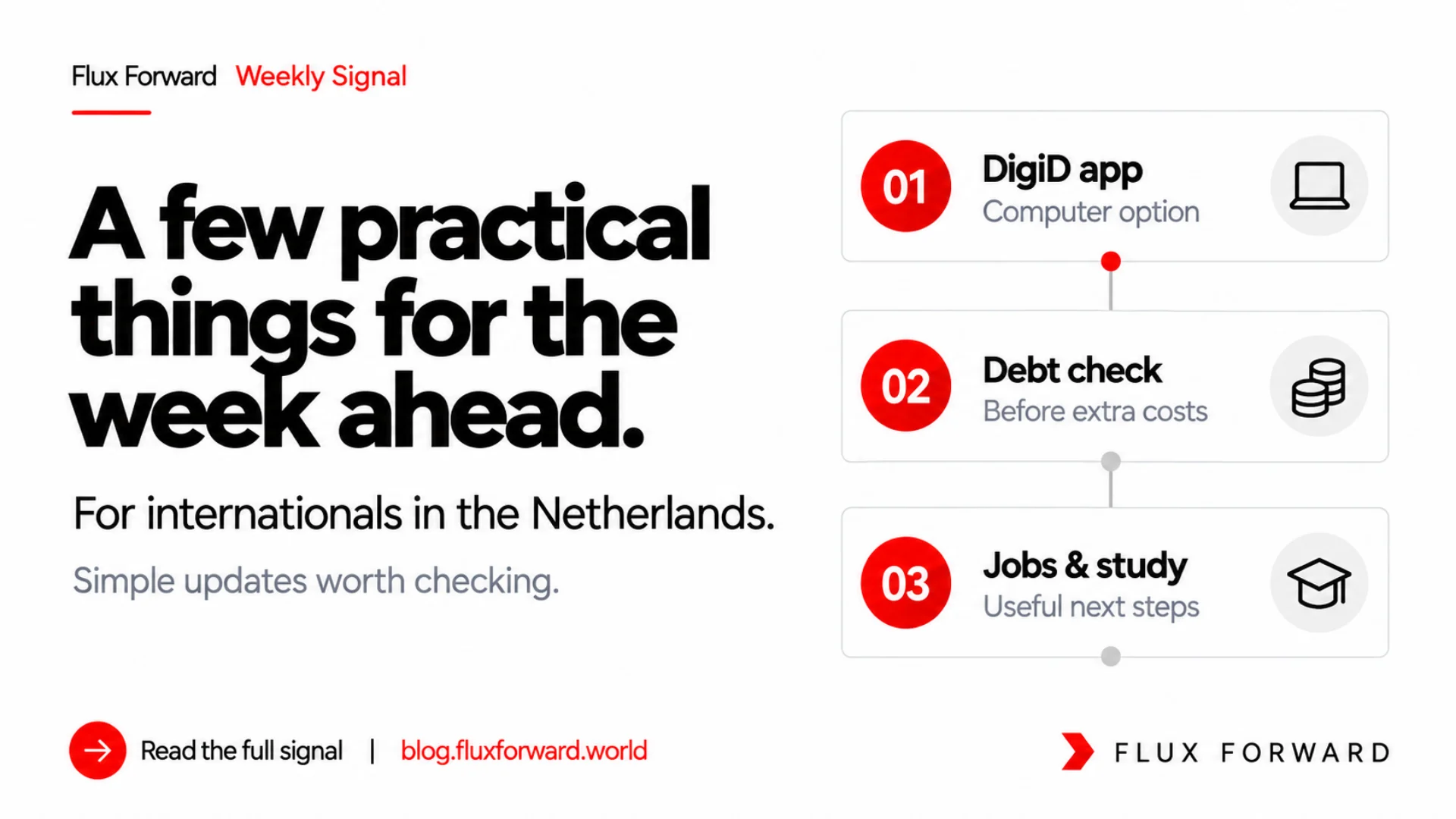
A few useful changes are worth knowing about this week.
One makes DigiD easier to use without a smartphone. Another changes what happens when an unregistered debt collection company contacts you. Border checks also change from 1 October.
And on our side, we have made some practical updates to the How to in NL Job Board and Study path.
You can now use the DigiD app without a smartphone
Since 24 September, the DigiD app can also be downloaded and activated directly on a computer.
This is mainly useful if you do not have a smartphone, or if using DigiD on a phone is difficult. Once activated, the app works on that computer and you use your personal PIN to log in. You no longer need to scan a QR code or enter a pairing code.
If not having a smartphone has stopped you from using the DigiD app, you now have another option.
Official source: Rijksoverheid, 24 September 2026
From 1 October, check who is collecting a debt before paying extra costs
If you receive a letter from a debt collection company, there is one extra check worth making from 1 October.
If a company collecting a debt on behalf of someone else is not registered in the official debt collection register, you do not have to pay the collection costs or the interest that continues to build up.
The original debt still has to be paid.
You can check the company in the public register maintained by Justis.
Hopefully you will never need this one. But if a collection letter does arrive, it is useful to know where to check before paying extra costs.
Official source: Rijksoverheid, 21 September 2026
Check the register: Justis, Register incassodienstverlening
Border checks are changing from 1 October, not disappearing
The temporary internal border controls that have been in place since late 2024 end on 30 September.
From 1 October, checks continue under an expanded Mobiel Toezicht Veiligheid framework. The Marechaussee will have more flexibility to decide where and when to carry out checks around the Belgian and German borders, based on information and risk.
So if you regularly cross these borders, do not assume that the end of the temporary controls means the end of checks. The Marechaussee advises travellers to carry a valid passport or identity card.
Official source: Rijksoverheid, 24 September 2026
Travel document guidance: Royal Netherlands Marechaussee
Looking for work? We have made the Job Board a bit more useful
We have also been working on the How to in NL Job Board.
It currently lists 183 positions from 28 employers on the IND public register of recognised sponsors, with the feed last checked on 27 September. You can search by job title, employer or place, and filter by opportunity type, workplace and employer.
Recent vacancies are easier to find, and the listings now show things like posted dates, deadlines, language and sponsorship information when the original vacancy actually provides them.
One thing has not changed: being on the IND recognised sponsor register does not mean every vacancy at that company comes with sponsorship.
A better sequence is:
Find the company. Check the vacancy. Then check the sponsorship fit.
And when you want to apply, you always go to the employer's own site.
Explore the How to in NL Job Board
Planning to study in the Netherlands? The Study path now starts earlier
The How to in NL Study path now covers 28 steps, from choosing a programme to what comes after graduation.
It starts with finding a programme and checking admission requirements, then moves through Studielink, the university application, tuition and costs, the student residence permit and preparing to move.
After arrival, it covers municipality registration, BSN, DigiD, banking, health insurance, student work and study progress.
And when graduation gets closer, it connects to the next routes too: the orientation year, finding work, starting something of your own or continuing into a PhD.
The point is not to work through 28 things at once.
Find the stage you are actually in and start with the next step that matters now.
And one thing for organisations working with internationals
We are also now offering an Activation Workshop for teams working with international students, graduates, employees or founders.
It is a practical 60 to 90 minute session built around a simple question:
Before adding another programme, event or support service, where are people actually getting stuck?
The workshop uses four lenses, Stability, Navigation, Translation and Visibility, to look at one real transition moment, reflect on the support that already exists and identify one realistic next step.
It is not HR consulting or recruitment strategy. The aim is to make the problem clearer before adding more solutions.
See the Activation Workshop for organisations
You do not need all of this
If DigiD has been difficult because you do not use a smartphone, check the new computer option.
If you receive a debt collection letter, check the register before paying extra costs.
If you are looking for work, have a look at the Job Board.
If you are planning to study in the Netherlands, start with the Study path and the stage you are in now.
And if your organisation already supports internationals but people still seem to get stuck somewhere along the way, the Activation Workshop may be a useful place to start.