
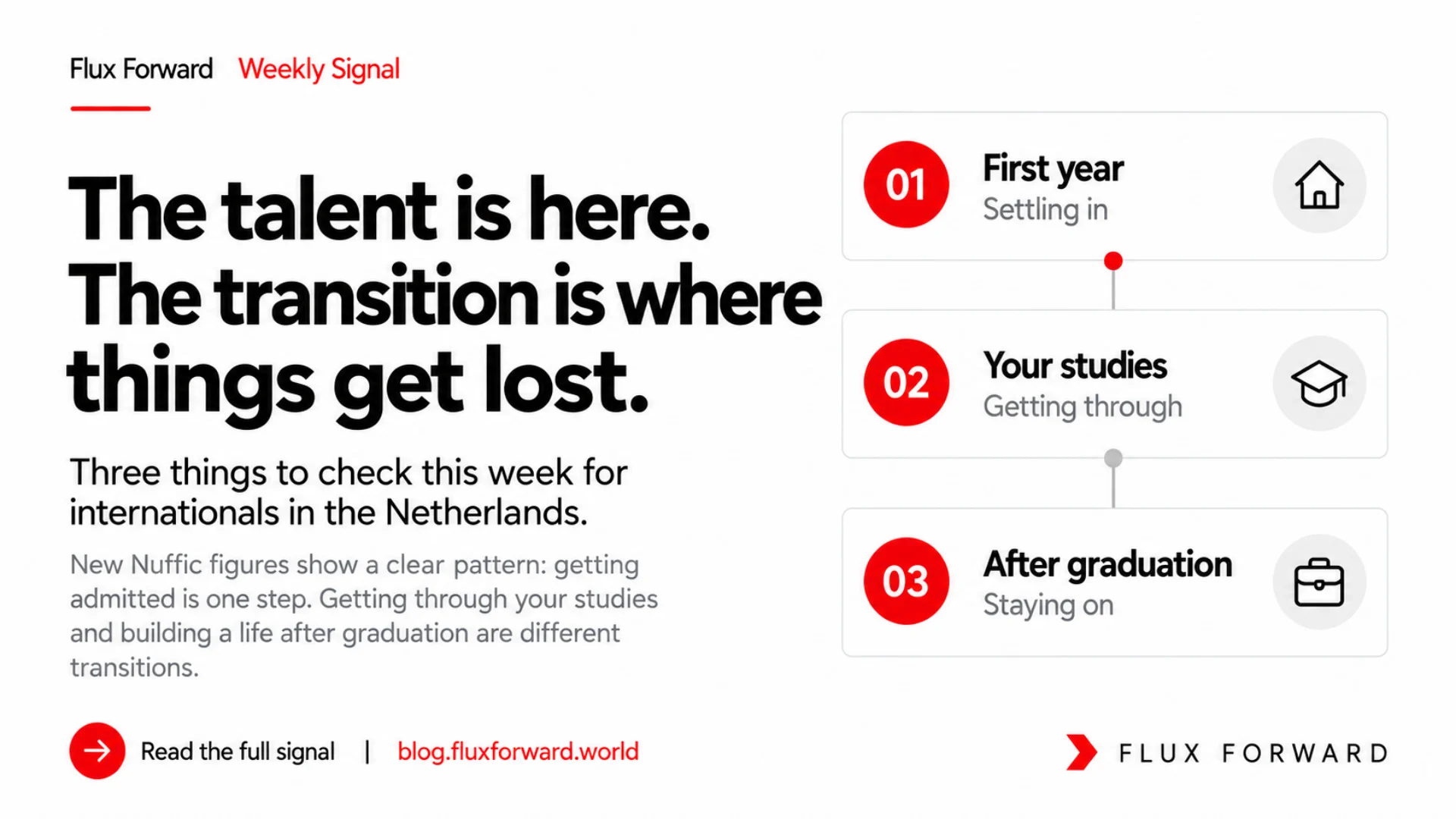
The Netherlands is still a major destination for international students.
In the 2025-26 academic year, 129,764 international students were enrolled in full bachelor's or master's programmes at publicly funded Dutch higher education institutions. That is 17% of the total student population. At research universities, the share is 27%.
These numbers often lead to a familiar debate: should the Netherlands attract more international students, or fewer?
But Nuffic's new 2026 overview raises another question that may be more useful for someone who is already here:
What happens after you arrive?
For someone starting a degree, approaching graduation or thinking about staying in the Netherlands, that question may matter more than the total number of international students.
Getting in is not the same as settling in
One of the most striking figures in the report is about the first year.
Among international students starting a bachelor's programme at a research university, 12% drop out during the first year. For Dutch students, the figure is 3%.
But the four-year completion figures tell a different story.
After four years, 69% of international bachelor's students at research universities have obtained a degree, compared with 62% of Dutch students. At universities of applied sciences, the figures are 58% for international students and 50% for Dutch students.
These numbers do not tell us why students leave in the first year. They do not prove that housing, loneliness or any other individual problem causes someone to drop out.
But they do make one simple explanation harder to accept: that international students are simply less able to handle Dutch higher education.
The academic picture is more complicated than that.
Nuffic's overview also brings together research on what is happening around the study itself.
International students deal with language barriers, cultural differences, financial worries and housing problems. A weaker local network and distance from family can make it harder to find support. Some are unfamiliar with the Dutch healthcare system or other local systems. Adjusting to Dutch educational culture can also take time.
Nuffic also notes that international students are more vulnerable to housing scams and discrimination than Dutch students, and that a majority are dissatisfied with the amount of interaction they have with Dutch students.
None of these issues is unusual on its own.
The difficulty is that several of them can happen at the same time.
Your studies may be going well while your housing is unstable.
You may have found a room but still have no local network.
Your degree may be fully in English while much of the life around it is not.
A problem in one part of the transition can make the next part harder.
Graduation is not the end of the transition
The same question comes back after university.
More than half of international students surveyed in research cited by Nuffic say they are likely or very likely to want to stay in the Netherlands after graduation.
But five years after graduation, about a quarter of international graduates are still living here. Nuffic's most recent stay-rate study puts the figure at 25.3%.
The difference between groups is significant. After five years, the stay rate is about 39% for graduates from outside the EEA and 20% for graduates from within the EEA.
And among the international graduates who are still in the Netherlands after five years, 80% have paid work.
There is an important caveat here.
The students who say they would like to stay and the graduates measured five years later are not one single cohort. So we should not subtract one percentage from the other and call the difference a retention gap.
Wanting to stay and being able to build a life here are not the same thing.
A separate Nuffic study on the transition after graduation shows some of the problems graduates run into. Dutch language requirements when applying for jobs, finding housing, finding suitable work, building social and professional networks, and residence or work permit issues all appear among the challenges.
For students, there is a practical point here.
If you think you may want to stay after graduation, you do not need to wait until graduation to start thinking about it.
You do not have to solve everything at once either.
But it helps to understand the Dutch labour market, start building a network, know what your residence options may look like, and identify the places where Dutch language skills could actually change your options.
The useful question is not, "How do I prepare for everything?"
It is, "What could become a bottleneck later if I ignore it now?"
This is not only a student problem
There is another side to this story.
The Dutch labour market remains very tight. UWV says the ratio between vacancies and unemployed people is the highest in the European Economic Area. Shortages are particularly common in areas such as healthcare and welfare, ICT and technical professions.
At the same time, Nuffic points to a change in engineering education.
The number of Dutch students entering engineering programmes at universities of applied sciences and research universities has been falling since 2020-21. International enrolment has been moving in the other direction. At research universities, international engineering enrolments rose by 12% compared with 2024-25.
Nuffic argues that this growing international intake is helping to reduce shortages in engineering.
And when international graduates stay, many do move into sectors where people are needed.
Among international healthcare graduates who are still in the Netherlands five years after graduation, 74% work in healthcare. For international graduates in education, the figure is 95%.
And of the international graduates who are still working in the Netherlands five years after graduation, 9% work in ICT.
So the talent is here, and parts of the labour market clearly need it.
But there is still a transition between the two.
That transition does not happen automatically.
A separate Nuffic study looked at the employer side of the same issue. The research included a survey of 382 employers and conversations with 34 company representatives.
Nearly eight in ten employers said they mainly saw advantages in hiring international graduates. They mentioned diversity, specialised knowledge, personal qualities and innovation.
At the same time, employers pointed to language barriers and administrative burdens. Some also said the connection between higher education and the labour market could be better.
So this cannot only be framed as a question of whether an international graduate is trying hard enough.
Universities, employers, cities and the wider system all shape the transition too.
The signal this week
Maybe the most useful thing in these numbers is simple:
Attracting people is only the beginning.
You can have an admission letter and still not be settled enough to study well.
You can be academically capable and still get stuck during the first year because several other things around you are unstable.
You can want to stay after graduation and still have no clear path from education into work.
And an employer can genuinely need international talent while still not being ready to hire or retain it.
At Flux Forward, we do not usually see these situations as a simple problem of "trying harder".
Action also depends on the conditions around it.
Is your basic situation stable enough?
Do you understand the next step and how the system works?
Can the right people and opportunities find you?
And can what you already bring, your skills, experience, qualifications and goals, be understood and used in this new context?
You do not need to fix all of those things at the same time.
But when you are going through a transition, there is one question worth asking:
Instead of only asking what your next step is, ask what could stop you from taking it.
Sometimes that is where the real signal is.
Sources and practical links
- Nuffic: International students in the Netherlands 2026
- Nuffic: Internationale studenten in Nederland 2026
- Nuffic: Stay rate and labour market position of international graduates
- Nuffic: This is why international students stay or leave after graduating in the Netherlands
- UWV: Vaak aanbod in Europa voor Nederlandse tekortberoepen
- Nuffic: Internationale afgestudeerde biedt bedrijfsleven meer voor dan nadelen
This Weekly Signal provides general information. It is not educational, immigration or employment advice.