
The Activation Journey
The invisible phases of integration most systems ignore

Integration is often described as a process you can plan.
You arrive in a new country. You register. You build a network. You apply for jobs or start something new. Step by step, things are supposed to fall into place.
If you are an international, you already know that this description rarely matches reality.
What usually happens is quieter and more confusing. You are active, you are trying, you are doing what is expected. And yet, very little seems to move. Over time, that gap between effort and outcome starts to weigh on you.
At some point, many people stop asking what is happening around them and start asking what is wrong with them.
Why time is the wrong way to think about integration
One of the most common questions we hear is how long integration takes.
Three months?
Six months?
A year?
In practice, time is a poor measure. People don’t struggle because something takes longer than expected. They struggle because of what happens internally while they are waiting.
Two people can arrive at the same moment and have very different experiences. One may feel grounded within weeks, another may still feel stuck after a year or more. This difference is rarely about talent or motivation. More often, it has to do with the psychological phase someone is moving through and whether they understand it.
A different way of looking at it
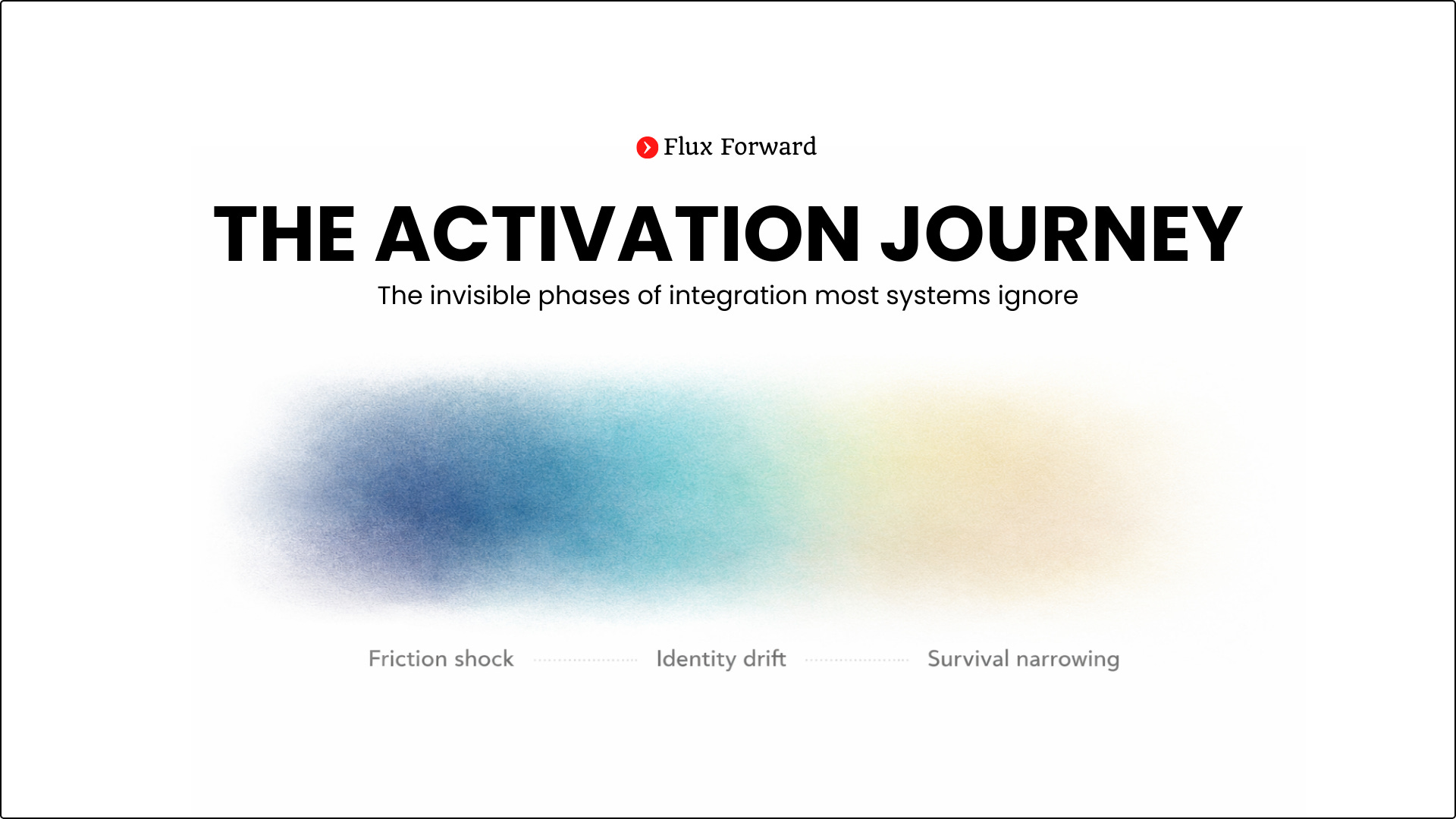
In Flux Forward, we map what we call The Activation Journey.
It is made up of invisible phases of integration that most systems don’t really acknowledge.
These phases are not linear and they don’t follow a fixed timeline. People can move forward, stall, or circle back without realizing what is happening. When things start to feel heavy, it is usually not because someone is failing. It is because they are in a phase they were never taught to recognize.
Friction shock
For many people, the first real difficulty shows up after the initial excitement fades.
You start reaching out. You apply. You go for coffees. You try to understand how things work. And then you encounter silence. Messages don’t get answered. Conversations stay polite but vague. Opportunities don’t materialize.
Without context, this feels personal. It feels like rejection.
In reality, this phase is often about learning how closed and trust-based systems work, even when they appear open from the outside. The problem is not a lack of effort, but a lack of feedback. When people don’t understand that, they turn system friction into self-doubt.
Identity drift
If that friction continues, something deeper can start to shift.
People who were confident and established in their previous context begin to feel unsure. Skills that once made sense suddenly seem invisible. You start adjusting how you present yourself, sometimes too much, sometimes not at all.
This phase is painful because it is not just about work. It touches identity. You lose familiar reference points, but you haven’t found new ones yet. Many people assume they are doing something wrong, when what is actually happening is a temporary loss of orientation.
Survival narrowing
At some point, pressure enters the picture.
Financial pressure.
Visa pressure.
Family pressure.
The quiet pressure of time passing.
Focus narrows. Big questions about direction or purpose are replaced by a more basic one: how do I stay afloat?
For many people, this phase comes with shame, especially for those who used to feel in control. But survival is not failure. It is a rational response to uncertainty. What makes this phase hard is the fear that it will last forever.
Why naming these phases matters
Most integration efforts focus on action. Better CVs. More networking. More resilience.
But action without interpretation can make things worse. When people don’t understand the phase they are in, they internalize systemic silence as personal failure. That is where confidence erodes and people quietly burn out or give up.
Naming the phase does not magically solve the situation. But it changes the story people tell themselves. And that story shapes how long they can keep going.
We see the same patterns repeat at very different moments for different people, often triggered by silence, comparison, or pressure rather than time itself.
A quieter truth
Integration is not only administrative or professional. It is psychological.
Much of the real struggle happens in the space between effort and outcome, where nothing seems to respond. That space is rarely talked about, but it carries a heavy cost.
If this resonates with you, there is nothing wrong with you.
You are not late, behind, or broken.
You are in a phase. And phases become more manageable once they are seen clearly.
If you’re navigating something similar, you don’t have to figure it out alone.
You can book a 30-min Direction Session 👉 here