
How activation actually happens
Understanding the four dimensions that drive real progress

Over the past months, a question kept coming up in our work at Flux Forward.
Why do capable internationals, with solid backgrounds and real motivation, still struggle to move forward in the Dutch job market?
On the surface, the answers seem obvious. Skills, experience, effort. But the more conversations we had, the less those explanations held up.
What kept showing up instead was a pattern. People were doing a lot, but not necessarily moving. And it didn’t come down to one missing piece. It was more about a set of conditions that weren’t fully in place.
That’s where we started to look at activation differently. Not as something you either do or don’t do, but as a system. Something that either supports progress or quietly slows it down.
What activation actually means
Activation is often understood as doing more. Sending more applications, going to more events, trying harder.
In practice, that’s rarely where things break.
What we consistently see is a mismatch between what someone brings and how that value shows up in a new context. People have experience, but it doesn’t land. They are active, but it doesn’t convert into opportunities.
So activation, in this sense, is less about volume and more about whether the right conditions are in place for action to work.
The four dimensions behind real progress
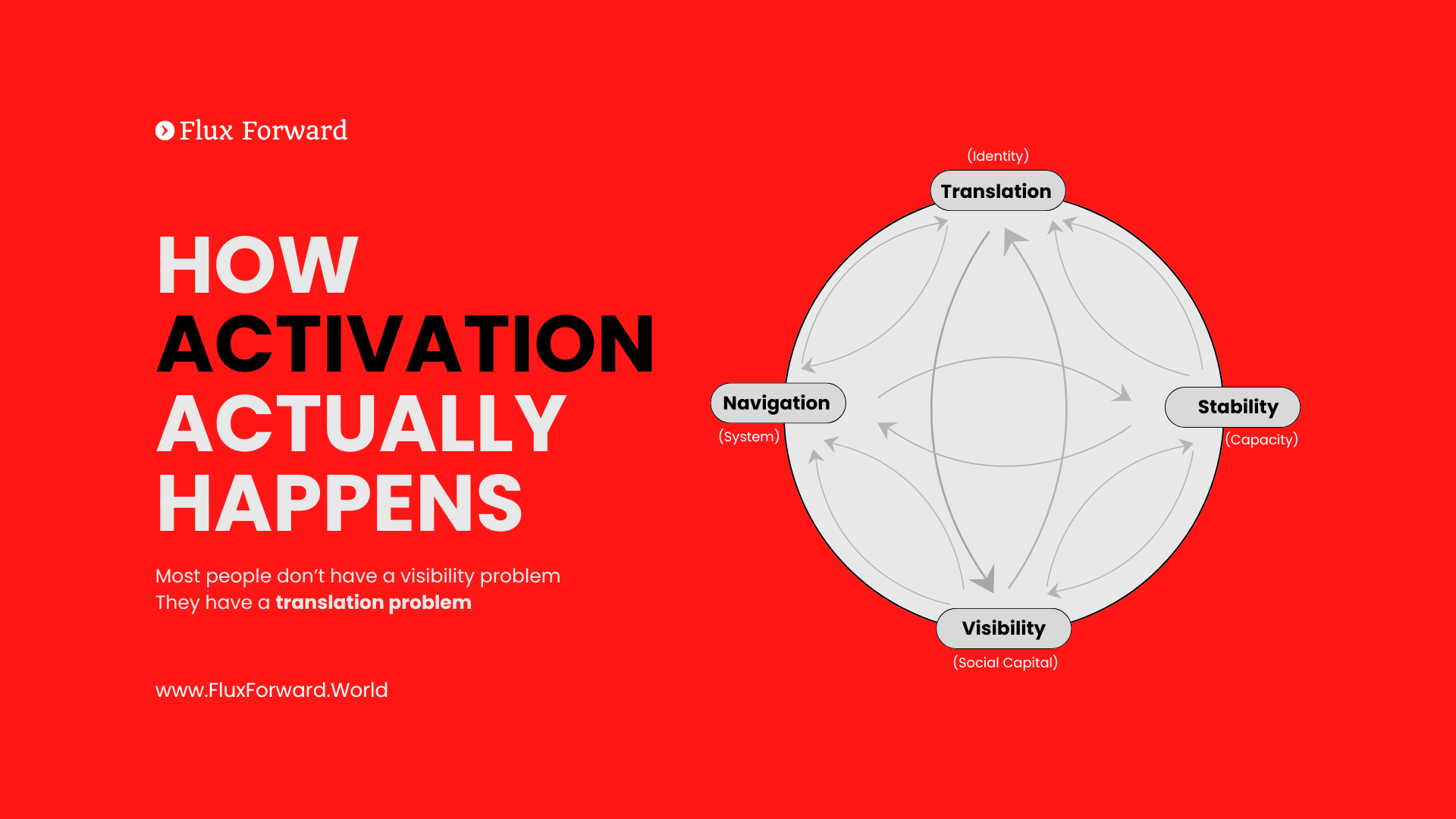
Over time, this started to take shape as a system with four recurring dimensions.
Stability (capacity)
The ability to think clearly, take action, and move forward without being pulled into survival mode.
Translation (identity in context)
The ability to express who you are and what you bring in a way that makes sense in this environment.
Navigation (understanding the system)
The ability to understand how the job market actually works, beyond what is visible on the surface.
Visibility (social capital)
The ability to be seen, recognized, and considered in the spaces where opportunities are created.
These dimensions don’t operate in a fixed order. People move between them, and friction in one often affects the others.
Why more effort doesn’t solve it
When things don’t work, the default reaction is to do more. Apply more, reach out more, try harder.
But when one of these dimensions is off, more effort often leads to more frustration.
If the system isn’t clear, actions are misdirected.
If translation is missing, value isn’t recognized.
If stability is low, consistency becomes difficult.
If visibility is limited, opportunities don’t show up.
At that point, it’s no longer about effort. It’s about alignment.
It’s often not a visibility problem
One pattern that keeps repeating is this.
Many people assume they need more visibility. But in many cases, visibility is not the core issue.
They are already showing up. They are applying, posting, attending, trying to connect.
The real issue is that what they bring is not clearly understood in this context. And without that translation, visibility alone doesn’t change much.
You can be seen and still not be recognized.
From potential to contribution
Looking at activation as a system shifts the question.
Instead of asking what to do more of, it becomes more useful to ask what is currently getting in the way.
This is the lens we are using at Flux Forward to make sense of what we see across different journeys, and to design more targeted ways of supporting internationals as they find their footing in the Netherlands.
Where do you see the biggest friction right now?