
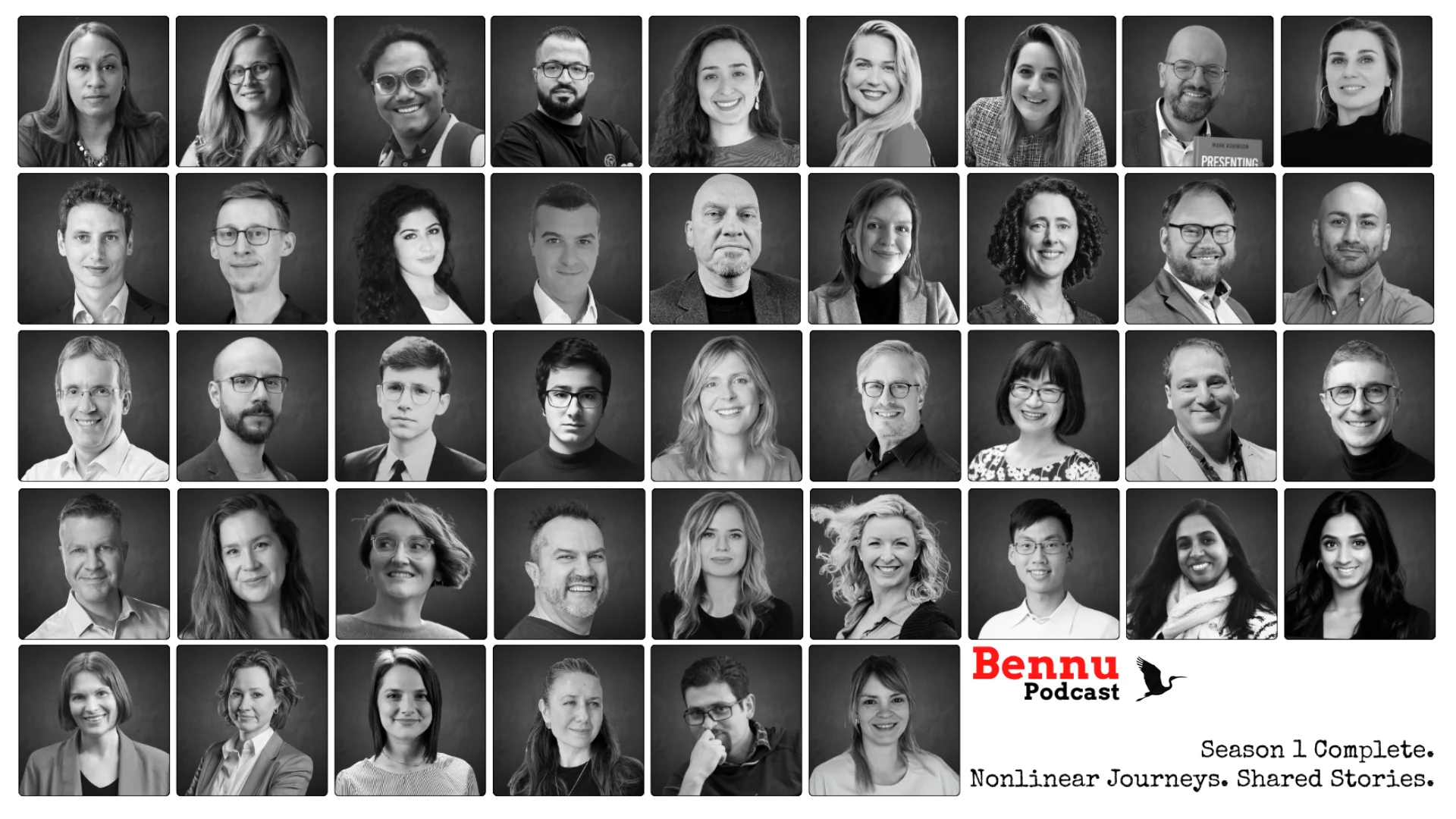
Bennu Chapter One started as a podcast season. Over 40 long conversations, it brought together internationals, founders, creatives, researchers, builders, community voices, learning practitioners, futurists, and people moving through different kinds of change.
Looking back, it became more than a list of episodes. It became a living archive of people trying to find their way while things were still uncertain.
The conversations were not only about careers, migration, identity, work, learning, or belonging as separate topics. They kept circling back to a simpler and more practical question: what helps people move when the path is unclear?
That question now sits close to the heart of Bennu by Flux Forward.
Chapter One showed that future-readiness is not one skill, one mindset, or one type of personality. It is something more grounded than that. It depends on the conditions around a person: enough stability to think, enough language to explain value, enough context to navigate, enough visibility to be recognized, and enough belonging to keep going.
A living archive, not old podcast content
Bennu Chapter One should not be treated as old podcast content. The conversations are still useful because the questions inside them are still active.
Across the season, guests spoke about moving countries, rebuilding professional identity, learning in new environments, building companies, working with uncertainty, speaking in public, creating psychological safety, imagining futures, using AI with more care, and building communities that actually support people.
The topics were different, but the same tensions kept returning. People were trying to be seen without performing a version of themselves that did not feel true. They were trying to explain their value in systems that did not always know how to read it. They were trying to stay steady enough to continue, while also searching for work, community, and language that fit who they were becoming.
That is why Chapter One matters for Flux Forward. Bennu keeps the human story alive. Flux Forward helps read the signal underneath it.
Future-readiness is not linear
Many stories in Chapter One did not follow a straight path. People moved across countries, fields, roles, identities, and turning points. Their journeys were shaped by change, experiments, setbacks, pauses, and new starts.
That matters because many systems still read people through simple markers: job titles, degrees, timelines, credentials, and familiar career paths. Those markers can be useful, but they often miss the value that comes from a less linear life.
Some of the strongest future-ready qualities in Chapter One came from moving between contexts. Guests had learned how to adapt, connect ideas, recover from disruption, read a room, translate experience, and keep learning when the old map no longer worked.
So future-readiness, in this archive, is not about having a perfect plan. It is closer to the ability to keep becoming when the plan changes.
Transition is translation
One pattern became clearer the more I looked back at the season: transition is not only movement. It is translation.
When someone moves to a new country, changes career, starts a company, enters a new field, or changes their relationship to work, they do not only need to get from one place to another. They need to make their experience understandable in a new context.
That translation can be professional, cultural, emotional, institutional, or personal. A researcher may need to translate scientific knowledge into market language. An international professional may need to translate experience from one labour market into another. A founder may need to translate a technical idea into customer value. A quiet leader may need to make their strength visible without pretending to be someone else. A person in transition may need to find new words for who they are becoming.
This is one of the clearest lessons for Flux Forward: people are not always missing value. Often, their value is not yet easy for the system around them to read.
International talent needs context, not only opportunity
Chapter One also says something important about international talent. The challenge is not mainly lack of ambition.
Many internationals carry experience, knowledge, motivation, and capability. But those things do not automatically become visible or usable in a new context. The harder gap is often context.
People need to understand how local systems work, how trust is built, how networks form, how employers read value, how communication norms change, and how their own story makes sense in the new environment. More advice can help, but advice alone is not enough. More vacancies can help, but access to listings is not the same as access to opportunity. More events can help, but events do not automatically create belonging or recognition.
International talent needs context. That means support should not only ask how to help people find jobs. It should also ask how to help people explain their value, read the system, become visible in the right spaces, and build enough stability and belonging to keep moving.
That is the difference between treating international talent as a pipeline and treating it as an activation challenge.
Stability comes before action
Another signal that kept showing up was stability.
Future-readiness is often described through ambition, speed, growth, and action. Chapter One showed a more grounded picture. People do not move well when they are overloaded, isolated, unseen, or stuck in survival mode.
They need enough steadiness to think clearly. They need trust, rhythm, psychological safety, space to reflect, and some permission to slow down when slowing down is what makes movement possible.
This does not make stability the opposite of ambition. It makes stability one of the conditions for meaningful action.
For Flux Forward, this matters because activation is not only about pushing people toward the next step. It is also about noticing what needs to become stable enough for that next step to work.
Navigation keeps showing up
Navigation was the strongest recurring activation lens across Chapter One, and that makes sense. The season was full of people trying to move through uncertainty: new countries, new systems, new roles, new futures, new technologies, new identities, and new forms of work.
They were not only looking for advice. They were trying to read the environment. Where am I? What is changing? What matters here? Which signals should I trust? Who can help me understand the system? What route is possible from where I am now?
Navigation is practical, but it is also emotional, social, cultural, and strategic. This is especially true in the future of work. People are not only choosing between clear options. They are often trying to understand what the options actually mean.
Chapter One suggests that good support should not make complexity disappear too quickly. It should help people move through complexity with more clarity, language, and confidence.
Visibility is not performance
Visibility appeared in fewer episodes than navigation, but it carried a strong signal.
Chapter One did not frame visibility as personal branding for its own sake. Visibility was more about recognition: networking as trust, public speaking as clarity, quiet confidence as presence, and ecosystem work as making missing actors, gaps, and voices easier to see.
That distinction matters. The goal is not to make people perform louder. The goal is to help value become easier to recognize in the right context.
For international talent, founders, creatives, and people in transition, visibility can become a bridge between hidden potential and real opportunity. But visibility only works when it is connected to trust, story, and context.
Belonging makes movement possible
Belonging is often treated as a soft theme. Chapter One suggests the opposite.
Belonging is part of activation. When people do not feel allowed to belong, they often hesitate, withdraw, overperform, or disconnect. When people feel seen, trusted, and able to contribute, they move differently.
Belonging affects whether people ask for help, whether they show up again, whether they take risks, and whether they can imagine a future in a place, team, community, or ecosystem.
This is why belonging cannot be separated from work, learning, retention, innovation, or contribution. People move better when they are not solving transition alone.
Learning is moving, not consuming
Chapter One also challenged a narrow idea of learning.
Learning did not appear only as content, training, or skill acquisition. It appeared as movement. People learned through doing, feedback, reflection, community, mistakes, conversations, tools, work, and identity change.
That matters for the future of learning. If the world is changing quickly, learning cannot only be a library of content people consume when they have time. It needs to be connected to real situations.
The question is not only what someone needs to know. The better question is what someone needs to understand, practice, translate, or try next in order to move.
Futures literacy is everyday practice
Several Chapter One conversations explored futures literacy directly. But one of the most interesting things is that futures literacy also appeared indirectly, as something people were practicing in everyday life.
People were imagining alternatives, questioning assumptions, using uncertainty as a space for reflection, learning to act without full control, connecting personal transition to wider systems, and using the future to see the present differently.
This gives Flux Forward a useful way to talk about futures literacy. It is not about predicting tomorrow. It is about changing the quality of attention today: what people notice, what they can imagine, what they can discuss together, and what they feel able to do next.
Ecosystems need memory
Chapter One also revealed something about ecosystems.
Ecosystems do not become useful simply because they have many actors, events, programs, or conversations. They become useful when people can see one another, understand one another, and support movement across roles, needs, and gaps.
That requires memory. Without memory, valuable conversations disappear after the event, episode, campaign, or introduction ends.
Bennu creates one form of ecosystem memory. It preserves stories that show where people are getting stuck, where support is missing, where translation is needed, where belonging matters, and where opportunity depends on better visibility.
For Flux Forward, this points to a broader role: helping ecosystems read the human signals already inside them.
What this means for Flux Forward
Bennu Chapter One strengthens the role of Flux Forward as more than a media platform, community project, or advice space.
The archive points toward Flux Forward as an activation layer. That means helping people and ecosystems move from story to signal, from potential to readiness, from confusion to orientation, and from hidden value to meaningful contribution.
The pattern is simple, but useful: stories reveal signals, signals reveal stuck points, and activation lenses make the next move clearer.
Through Bennu, Flux Forward can keep listening to the human side of transition. Through the Activation Framework, it can help make those stories useful. Through FluxOS, it can structure the memory and patterns behind the work. Through Fluxy, it can help people explore what a story might mean for their own situation.
What this means for Chapter Two
Chapter One was about becoming in practice. Chapter Two can build on that by becoming more intentional about signals.
It can explore the edges of work, migration, belonging, learning, futures literacy, AI, ecosystem building, and direction with a clearer question underneath: what helps people move?
This does not mean Bennu should become less human. It means the human story can become even more useful.
The next chapter can keep the depth of conversation while making the activation signals easier to find, connect, and use.
Explore Chapter One
Bennu Chapter One is complete, but it is not finished being useful.
The 40 conversations remain available as an archive for anyone navigating transition, working with international talent, building community, leading through uncertainty, or trying to understand what future-readiness looks like in practice.