
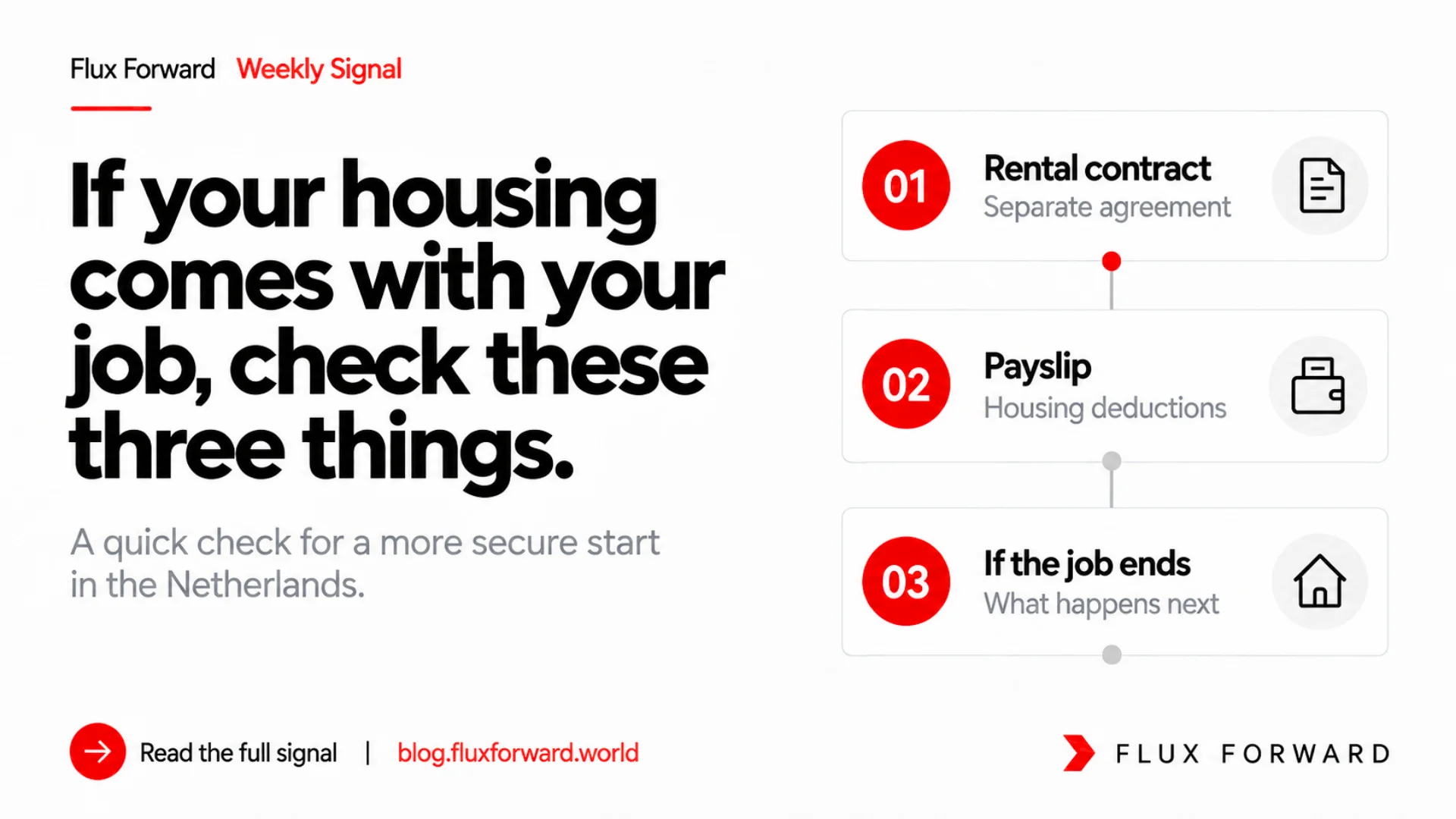
Your rental contract, your payslip, and what happens if the job ends.
If your employer or employment agency also arranges your housing in the Netherlands, it is worth knowing exactly how the two are connected.
On 10 September 2026, the Dutch government announced plans to stop employers from deducting housing costs from the minimum wage. The change is aimed at giving migrant workers more protection.
Right now, housing costs can still be deducted from the minimum wage under certain conditions, up to 25% of the gross minimum wage.
The government says it wants to stop rogue employers from using housing and wage deductions as a way to make money. It also says many migrant workers are too dependent on the same employer for both their income and their home.
An earlier review found that employers often deducted the maximum amount even when the quality of the housing did not always justify it.
Source: Rijksoverheid, 10 September 2026
The government plans to end this system when the proposed Wet passende huurcontracten comes into force. The current target date is 1 July 2028.
That date is not final. The law is still a proposal, and the timetable could change. An earlier plan to start reducing these deductions from 2026 was dropped in October 2025.
Source: Rijksoverheid, 30 October 2025
None of this changes your contract or payslip today.
But if your housing already comes through your job, there are three things you can check now.
1. Do you have a separate rental contract?
Start with your paperwork.
Work in NL says that if your employer arranges your housing, you should have a separate rental agreement for the home. It should not be part of your employment contract.
The rental agreement should also say how much rent you pay and what happens to the housing when you stop working.
Source: Work in NL, Housing through your employer
There is also a specific legal rule for migrant workers covered by the Good Landlordship Act.
This includes EU citizens who normally live outside the Netherlands and come here temporarily for work.
For rental contracts that started on or after 1 July 2023, the employment contract and rental contract must be separate.
You should also receive written information about the housing in a language you understand. The rental contract itself can still be in Dutch.
Sources: Wet goed verhuurderschap, Article 1; Rijksoverheid tenant guidance
Check your contracts.
- Do I have one contract for my job and another for my housing?
- How much rent does the rental contract say I pay?
- Who am I actually renting from?
- How long does the agreement last?
- What does it say about stopping work?
If you cannot find a separate rental agreement, that is a good place to start asking questions.
2. Is rent being deducted from your wages?
Next, open your latest payslip.
Look for anything being deducted for rent, accommodation or housing.
Under the current rules, housing costs can only be deducted from the statutory minimum wage under specific conditions.
Rijksoverheid says:
- you must give written permission;
- that written permission must include your name, your employer's name, the amount that may be deducted and what the deduction covers;
- the housing must meet the required quality standards;
- the landlord must have the required certification, unless the home is rented from a housing corporation;
- the housing deduction cannot be more than 25% of the gross minimum wage.
Source: Rijksoverheid, deductions from the minimum wage
Work in NL lists SNF and AKF as examples of housing certification.
Some collective labour agreements set a lower limit. In parts of the agricultural sector, for example, the maximum is 20% of the minimum wage.
Source: Werkgeverslijn
Check your payslip.
- Is money being deducted for housing?
- How much?
- Is the deduction clearly shown?
- Did I agree to it in writing?
- Does that written agreement say how much can be deducted and what it covers?
- Is the housing certified, or rented from a housing corporation?
- Does the amount match what I expected from my rental agreement?
If you see a deduction you do not understand, ask for an explanation.
Work in NL advises workers who think too much has been deducted to ask their employer for a copy of the written consent and a breakdown of the costs.
Source: Work in NL, Deductions
One thing to keep in mind: the "What will change?" section on that Work in NL page still describes an older plan for reducing housing deductions. That plan was dropped in October 2025. The newer proposal is the one announced by the government on 10 September 2026.
3. What happens to your housing if the job ends?
This is probably the question you want answered before you actually need the answer.
What happens if your employment contract ends?
What if you decide to leave?
What if the employment agency no longer has work for you?
Do not rely only on what someone has told you verbally. Check what your rental agreement actually says.
If the legal rule above applies to you, and your rental agreement started on or after 1 July 2023, Rijksoverheid says that losing your job does not mean you have to leave the home immediately.
Source: Rijksoverheid, Step-by-step guide for tenants
That does not mean you can stay there indefinitely.
The type of rental agreement, how long it runs and the rules for ending it still matter.
Check what your rental agreement says.
- When does my rental agreement end?
- What does it say about my employment ending?
- Is there a notice period?
- Is something I have been told about leaving the property actually written in the contract?
- Who is my landlord if I need to discuss the tenancy?
If you do not know what happens to your home when the job ends, it is better to find out before your work situation changes.
If something does not look right
You do not have to decide by yourself whether your employer or landlord has broken a rule.
Work in NL has information points in several places in the Netherlands where you can get free information and advice about contracts, wages, housing, healthcare, taxes and other practical questions about living and working here.
Source: Work in NL, Information points
If the problem is about money being deducted from your wages, start by asking your employer to explain the deduction and show you the documents behind it.
If that does not solve the problem, Work in NL points to services such as Het Juridisch Loket, trade unions including FNV and CNV, and organisations such as FairWork. Suspected labour abuses can also be reported to the Netherlands Labour Authority.
If the problem is with the housing or your landlord, the route is different.
Every municipality has a reporting point for problems covered by the Good Landlordship Act. Depending on the issue, the Huurcommissie or the kantonrechter may also be able to help.
Source: Rijksoverheid, tenant guidance
You do not need to know the right route before asking for help.
Start with the documents you already have.
The signal this week
Housing through work can be convenient.
You arrive in the Netherlands and the same organisation helps arrange both a job and somewhere to live.
But that also makes it important to know where the employment relationship ends and the rental relationship begins.
There are three things worth checking.
Your rental contract
Do you have a separate agreement, and do you understand what it says?
Your payslip
Is housing being deducted from your wages, and can you explain the amount?
If the job ends
Do you know what your rental agreement says happens next?
You do not need to wait for a dispute to find these answers.
If one of them is unclear, that is a useful thing to check this week.
Sources and practical links
- Rijksoverheid: Minister plans to end rent deductions from the minimum wage, 10 September 2026
- Rijksoverheid: Earlier phase-out plan cancelled, 30 October 2025
- Rijksoverheid: Rent and health insurance deductions from the minimum wage
- Work in NL: Housing through your employer
- Work in NL: Deductions
- Rijksoverheid: Step-by-step guide for tenants
- Rijksoverheid: Good Landlordship Act tenant brochure
- Wet goed verhuurderschap, Article 1
- Work in NL: Information points
This Weekly Signal provides general information. It is not legal, employment or housing advice.